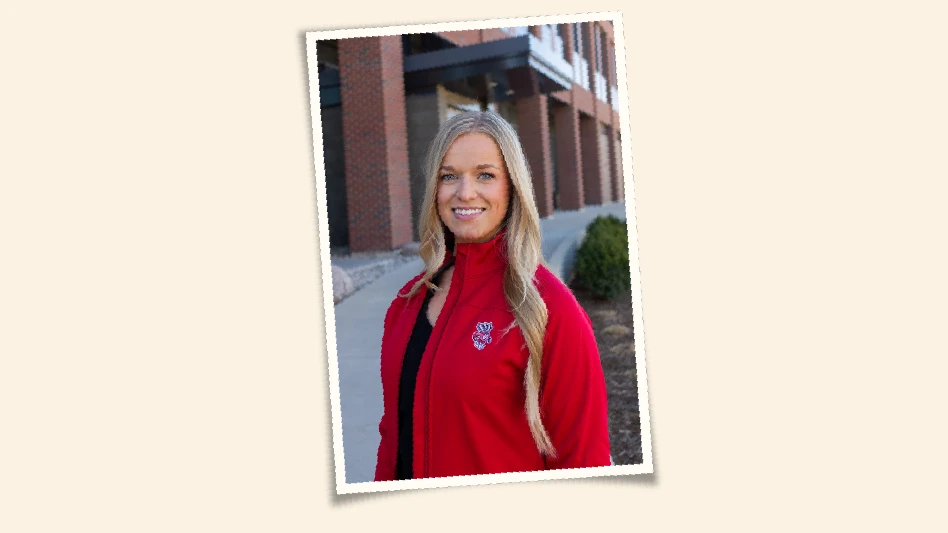
© photo courtesy Jordan Nehls
“You take your raw materials,” she said, “you form it in some way, cook it in some way, mix it in some way, and it comes out to be this awesome product. It’s so mysterious how it gets to that point. I’ve always found that really fascinating.”
After internships at Seneca and Post Consumer Brands, where she learned firsthand about food safety and quality, she graduated from the University of Wisconsin-Madison with a degree in food engineering. She got a job in food safety, quality and regulatory at Cargill.
“That’s where I’ve really found a super strong interest in food safety and the thermal processing side of things,” Nehls said.
She met Bob Hanson, an authority on thermal processing, who introduced her to an opportunity to pursue a master’s in meat science and conduct research in thermal processing and food safety. Nehls graduated in December 2022, and then a few weeks later took a position as FSQR manager of the USDA-inspected UW-Madison Meat Science & Animal Biologics Discovery.
We caught up with Nehls to talk about the focus of her master’s degree, what it’s like to work with a student workforce at a meat processing plant and more.
Q. What kind of challenges did you face going back to school?
A. Going back to school after being out for two to three years was nerve wracking. “I have to go to class again? This sucks!” But also I was nervous because I had never had experience in research before, and my parents did not get graduate degrees, so I had nothing to gauge the experience. It was also kind of exciting because my research was directly impactful to all the meat and poultry processors that use Appendix A Compliance Guidelines, which is why I wanted to do this. This research really matters.
Q. What did your research cover?
A. My project looked specifically at Salmonella that’s on the surface of meat and poultry products that are cooked in an impingement oven, which is a big convection oven with blowers that blow jets of hot air onto the top and bottom of the product. You have a really high risk of drying out that surface and therefore drying out the Salmonella on the surface. Once you do that, it’s hard to kill. We tested different conditions in the oven, different products — pork versus beef patties versus chicken tenders. We also tested out the difference in fat contents.
Q. What’s it like managing food safety and quality at a facility that’s staffed by college students?
A. It’s actually a lot better than you’d think. The students aren’t just animal science majors. We’ve got students studying everything from biology to medical to engineering to English. The students learn fast, and once you teach them something, it’s like second nature. They’re so willing to learn. As soon as you say, “We do this because of food safety,” you’ll never see them do it differently. We manufacture processed meats like snack sticks and sell them in our retail store, Bucky’s Varsity Meats.
Q. What was one of your favorite classes in the master’s program?
A. We have a class called Animal Meat Science 515: Commercial Meat Processing, and there was a question of if I should even take it because it was what I was already doing. I’m so glad I did, because it’s all the science behind why you do what you do. Why do you mix with this ingredient? Why do you mix it in first? Why do you mix it this long? I’m so glad I took it, because I would not have the knowledge I have now to teach the students coming in why we do what we do. And I think that’s really important to know.

Explore the March April 2023 Issue
Check out more from this issue and find your next story to read.
Latest from Quality Assurance & Food Safety
- Chef Robotics Introduces Pat-Down Capability for Meal Presentation and Sealing
- USDA Launches Regenerative Pilot Program
- Indoor Ag-Con Adds Food Safety Track to Conference Lineup
- IDFA Recognizes Federal Officials for Support of U.S. Dairy Industry
- Tetra Pak Acquires Bioreactors.net
- Fresh Del Monte Receives Rabobank Leadership Award
- São Paulo Earns Guinness World Record for Largest Municipal Food Security Program
- KPM Analytics Releases Ready-to-Use NIR Calibration Packages


